Results for ""


AI Experts 5 Min Read Nov 22, 2022
Expert Talk - A scholar should be a good mentor and a team player
 Published By : Dr Nivash Jeevanandam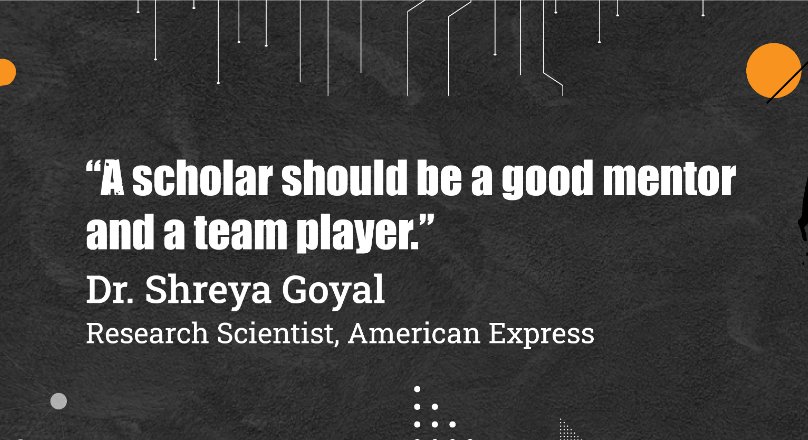
Shreya Goyal earned her Master of Technology and Doctor of Philosophy at the Indian Institute of Technology in Jodhpur, India.
Her primary research interests include computer vision, natural language processing, and interpretability, spanning both Artificial Intelligence and data science.
INDIAai interviewed Shreya to get her perspective on AI.
What similarities do you see between being a visiting researcher and a PhD scholar? What are all of the characteristics of Indian universities that need to be improved despite research activities?
A visiting researcher shares similar roles as a PhD scholar, as both require solving a research problem considering a long-term goal. However, a visiting researcher spends less time in a lab than a PhD scholar. Hence they need to be prompt in adapting to the lab environment. Indian universities need to focus on conducting extra-curricular activities other than research activities that promote the researcher's holistic growth. A particular focus on communication and presentation skills would be a great initiative.
Tell me about your PhD research topic and your research contribution.
My PhD research focussed on understanding architectural document images and generating a textual interpretation. It also concentrated on developing architectural 2D drawings with partial indoor scene images. My research contributed towards generating 2D architectural documents from multiple partial images of an indoor environment by stitching them using real-world coordinates and developing an interpretation from them for a holistic understanding of the indoor environment.
It paved a path towards using monocular 2D images instead of panorama images to understand the indoor environment and reduced the requirements of using advanced hardware such as depth-based cameras. Also, it bridged the gap between the graphical document image modality and text modality by generating textual descriptions from those above.
Despite AI research, who is your inspiration or role model?
My parents are my inspiration. They are hardworking and inspired me to never give up on failures which motivated me to become the person I am today.
What were your initial challenges in AI research? How did you compose yourself and overcome them?
My initial challenge in AI research was data collection. As having a large dataset is the primary requirement of training a machine learning model and collecting the data becomes the bottleneck situation. So, we took our time and started collecting data and got that annotated with the help of volunteers and students within the lab in the CSE department of IIT Jodhpur. After getting the data, the next challenge was the computing resources which is a vital requirement for training a large deep learning model. I want to thank the Department of computer science and engineering, IIT Jodhpur, for providing the facilities and sufficient resources to proceed with my research work. Also, I am thankful to my PhD supervisors and Department staff for their support in overcoming these challenges.
What, in your opinion, are the factors that Indian research scholars should improve before beginning their postdoc?
Before beginning their postdoctoral journey, researcher scholars should learn to be good mentors, along with good researchers. When students finish their research work in PhD, they focus on their PhD problem and its solution in a planned manner. However, a postdoctoral position begins a post PhD academic career with multiple responsibilities, such as mentoring students with their research work, working on numerous research projects simultaneously, and other academic activities. Hence being a good mentor and a team player is the next step, to begin with.
What is your typical day as a Research Scientist at American Express?
My typical day at AmEx depends upon the project I am working on. It refers to a few research papers, discussions within the team, planning and executing experiments to provide novel solutions to AmEx business problems and analyzing the results.
What advice would you provide to someone who wants to work in artificial intelligence research? What should they focus on to advance?
Working in AI research is not just about learning the tricks and techniques to train your model optimally for accurate predictions or tweaking the data for your use case. It is also about understanding the fundamentals of statistics and machine learning. For someone who wants to begin their career in AI research, learning fundamentals of probability theory, statistics, and Linear algebra, is highly recommended.
Please include some significant academic articles and books that have impacted your life.
Some books, such as Pattern recognition and machine learning by Christopher bishop and Deep Learning by Ian Goodfellow, Yoshua Benjio, and Aaron Courville, are highly recommended for someone keen to learn machine learning or AI. These books begin with the fundamentals of statistics, the basis for machine learning. Other than academic books, Ignited minds by Dr APJ Abdul Kalam, "Stay hungry, stay foolish" by Rashmi Bansal, and "To kill a mocking bird" by Harper Lee are some of the books which impacted my life.