Results for ""


AI Experts 7 Min Read Dec 26, 2022
Expert Talk - AI needs curiosity and creativity
 Published By : Dr Nivash Jeevanandam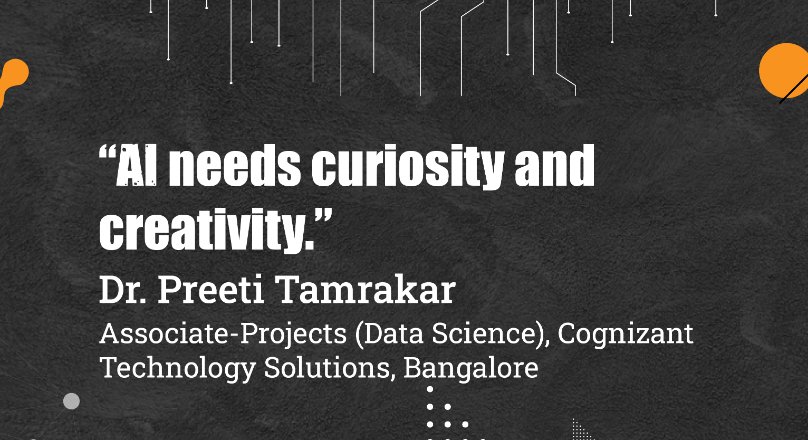
Preeti Tamrakar is a data scientist in the AI-COE area at Cognizant.
She has worked as a researcher on several classification approaches and feature selection methods. In addition, she creates AI/DL/ML-based applications for various clients.
INDIAai interviewed Preeti to get her perspective on AI.
What motivated you to transition from academia to the AI industry?
I was looking to contribute more towards solving real-world problems and faster growth. I wanted to explore both sides of the AI field, academia and industry. After my MTech from IIT (ISM) Dhanbad, I spent eight years in academia, and after PhD, it was time to experience the industry. The AI industry is the fastest-growing and evolving market. It has been two years in the industry, and I am determined to use my research skills to help the industry and give back to the world.
What initial challenges did you experience during this transition? How did you overcome them?
Academia is research-oriented, but the industry is execution-oriented, meaning there is a difference in the work nature of academia and industry. The sector may prefer to have something other than pure research minds in the team but look for problem-solving and programming-skilled people. I was required to change my work nature to adopt a culture of fast-moving and financial benefits of the industry. I worked on presentation skills to overcome these gaps, focused on productivity for fast outcomes and multitasking. Advertising myself on a social media platform like LinkedIn was a critical turning point for me to get accepted into the industry.
Tell us about your research in data science. What were your research contributions?
During my Academia tenure, I have worked on different classification and feature selection techniques during my research. The research aimed to construct an efficient lazy learning associative classifier to improve classification performance. So different associative classification approaches have been studied and proposed new innovative techniques in LLAC. Lazy learning is suitable for complex and incomplete problem domains, where datasets change frequently.
Classification is one of the essential methodologies used to predict group membership for unseen data instances. It uses supervised learning, in which class label is already present. It is a two-step process. In the first step,
- a model is constructed using the training datasets.
- The model is represented as mathematical formulae, decision trees, or classification rules.
- The second step is model usage for classifying unknown instances.
- The model is validated with the help of the test data set.
We can use it for applications where accuracy is more important over time constraints—for example:
- Fraud detection,
- Spam filtering,
- Cancer diagnosis,
- Weather prediction,
- Churn detection etc.
Currently, my research work in the industry is focused on Long Short-Term Memory (LSTM), which uses gates (Forget, Input, Output) to leave no longer valid information and utilize helpful information. It is used to build a smart model for the applications like Alert forecasting, Log anomaly detection, No code environment, and time series forecasting.
What is your day-to-day role at Cognizant Technology Solutions as an Associate-Projects (Data Science)?
In Cognizant, I work in the department of AI-COE. My responsibilities are to develop AI/DL/ML models for different customers. Python language is used in my work in that many tools are available, like Scikit Learn, Tensorflow, Theano, Keras, matplotlib, numpy, and pandas which help to program the concepts and algorithm. Based on these, user interface tools are developed, which allows users/ clients/ customers to build their software model for their application without coding.
The building model has to be advertised to the customer by giving demos and presentations. All models may not fit customer requirements/ needs, so feedback becomes essential to improvise and make it ready or valuable for the customer.
What qualities do you look for in a novice in the AI field?
Determined to work on AI with curiosity and creativity: A solid background in mathematics and statistics is helpful in traditional software engineering but mandatory for machine learning work. The fundamental knowledge of statistics, probabilities, and math allows machine learning engineers to understand which algorithms best address a problem and how to optimize outcomes.
Employers look for individuals with curiosity and creativity to excel in AI. These skilled set minds are the ones best able to solve the unclear problem and bring to light clarity around the possibilities prevalent in machine learning.
Tell us about your long-term AI research goals.
After having insightful experience credited with IIT and VIT culture and vast expertise in data science principles and practices, I gained sound knowledge during academics and while executing projects; a deep understanding of the data science domain. I aim to build a complex AI system with a no-coding environment for users (like ordinary people or non-AI background users) to avoid tedious tasks and be productive. The building model will help people avoid mistakes and accurately complete tasks.
What advice do you give students and professionals interested in working in artificial intelligence?
Artificial intelligence is a branch of computer science that includes the development of intelligent computer systems to solve problems that are not necessarily related to just computers but are in any domain or industry.
AI has been used in various applications, including data mining, machine learning, robotics, medical diagnosis and treatment, and many others. Many of AI’s breakthrough technologies, such as “natural language processing,” “deep learning,” and “predictive analytics,” are well-known buzzwords. Thanks to cutting-edge technologies, computer systems can grasp the meaning of human language, learn from experience, and make predictions.
I urge students and professionals to develop skills (coding and analytical) to find hidden problems in dumped massive data and solve them in many ways. But unfortunately, it is often granted that problem-solving and communication skills are the essential skillset an employer looks for in an aspirant.
Can you recommend any AI books or research papers to people just getting started in the field?
For those planning to pursue a spot in the AI field, you must start today by preparing yourself with the tools needed to execute the job successfully. Obtaining certifications in domains like machine learning and AI is a great place to start, and with the proper education, the opportunities are endless.
I suggest starting with udemy online course: “Machine learning A-Z: Python & R in Data Science” https://www.udemy.com/course/machinelearning/
and read articles on:
YouTube channels: