Results for ""


Ai Ethics 5 Min Read Feb 04, 2022
INDIAai tweetathon discoursed the ethical AI challenges for decades forthcoming
 Published By : Anjali Raja K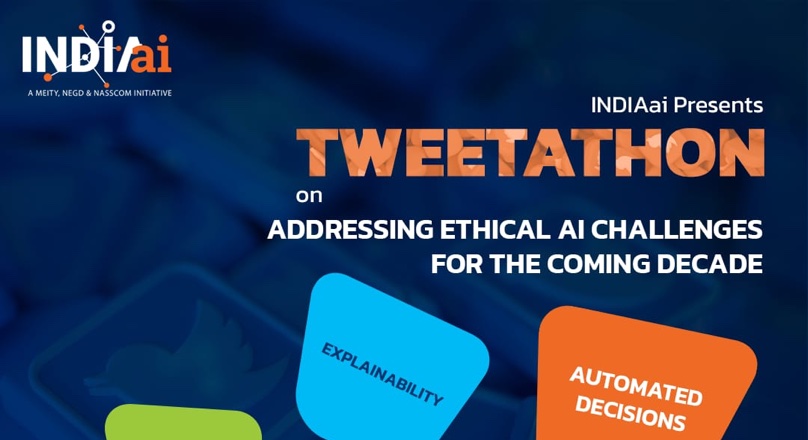
Artificial Intelligence has an impact on every domain of our life: education, news, health, culture etc. Ethics in AI help us question if the world is going on the right path in the development of technologies. The society we live in requires an insight into how AI will be capable of guaranteeing our security, dignity and human rights despite the differences that exist. With this thought in mind, INDIAai commenced a tweetathon on 'Addressing the Ethical AI Challenges for the Coming Decade’. The online event which was organised on 3rd February 2022, witnessed the active participation of people across the globe.
The discussion brought together the finest experts in the AI sphere. INDIAai collaborated with Rekha M Menon, Chairperson and Senior Managing director of Accenture in India & Chairperson- NASSCOM; Nigel Willson, Founding Partner Awaken AI; Shantanu Bhattacharya, Chief Technologist, Data & Platforms, NatWest Group; Jen Stirrup, Founder & CEO of Data Relish, Global Keynote Speaker; Parul Pandey, Machine Learning Engineer, Weight & Biases; Supriya Bhuwalka, Founder, Coding & More; Manan Suri, Associate Professor, Department of Electrical Engineering, IIT- Delhi; Ankit Desai, Director, Data Science, Locus; Usha Rengaraju, Chief Research Officer, Exa Protocol; Lubna Yusuf, Co Author- The AI book, Founder, LaLegal; Arjun Venkatraman, Program officer, Digital, Bill & Melinda Gates Foundation; Ankush Sabharwal, Founder & CEO, CoRover; Debjani Ghosh, President, NASSCOM.
The tweetathon filled with overflowing tweets in INDIAai’s official Twitter page questioned wealth inequality, AI decision-making capacity, accountability and liability, responsibility, and mitigations. Apart from the collaborators, the public who were interested in the subject as well participated. Anyone who wanted to join the discussion to express their thoughts and raise questions was asked to send their tweets to @officialIndiaAI with the tag #intoAIethics.
Significant Insights
The wealth inequality of AI has been a major source of concern over the years. Forbes magazine had reported that Artificial intelligence and other sophisticated technology has created an abyss about wealth and income inequality. According to Ankit Desai, “by 2030, we should empower and promote all social, economic, and political inclusion”. He also stated the importance of engineering sustainability and diversity in AI for overcoming the challenges of wealth inequality. Nigel Willson tweeted that the biggest issue in AI is that, it still has to be a lack of diversity, and solutions that are rushed to market causing unintended consequences. “We still need to fix the basics”, said Mr. Willson.
The decision making power of AI has been convenient, easier and faster. But a concern existed if it was always reliable. “Trust in AI is the key to realising its potential” stated Rekha M Menon. The world has always been sceptical to an extent about the result of AI actions. Debjani Ghosh raised questions by linking AI ethics with human ethics. “Given that we have failed to have a common code of conduct for humans, how will we agree on a common code for machines?” She asked. However, Santanu Bhattacharya thinks that AI will be more “fair” in the decision-making process than more humans ever could.
Vibhav Mittal called AI a “pattern detection tool” that runs on data. The more accurate the input data, the more accurate the results be. Retweeting Vibhav Mittal’s comment, Jen Stirrup shared that she hopes “we can learn something subtle about human learning as we progress to know more about #AI and how to train and test it properly”.
In a world where everything including the simplest decisions is dependent on AI, Lubna Yusuf thinks that even though it is convenient, AI poses a larger threat to the cognitive abilities of humans. The era where AI was confined into labs has gone. It is now a real-world application and has got a huge role in governance. If harnessed properly we believe that AI can contribute widely to the enhancement of economies. We should encourage the “transparency of algorithm and open data models”, says Ankush Sabharwal. The development of clean AI is critical for managing the outcome in different fields. To ensure that the AI is following “rules” and maintaining its fundamental responsibility, Parul Pandey suggests that everyone involved in a particular AI project should think about the impact that it is going to make. One similar question that constantly arises concerning AI is its misuse. As Himanshu Sharma proposes, questions like ‘ 'why to build this?' must be asked before 'how to build?' and 'what to build?’. Better data handling, refraining from replicating solutions for different use cases etc. can also be a substantial solutions to this challenge.
Future of Ethics in AI
With AI acting as the driver of innovations in fields across the globe, ethics in AI is one of the major concerns of the future. The INDIAai tweetathon on the subject opened the door to several thoughts that can enhance the development of morally maintained AI. AI has motivated the growth of emerging technologies such as big data, robotics and IoT. Ethical AI will go as far as ethical human intervention. Maintenance of good AI ethics will ensure the steady growth of AI as a technological innovator for the foreseeable future.