Results for ""


cervical cancer 8 Min Read Jun 25, 2020
Startup of the Week: Advocating early diagnosis & screening for cervical cancer with AI
 Published By : Sindhuja Balaji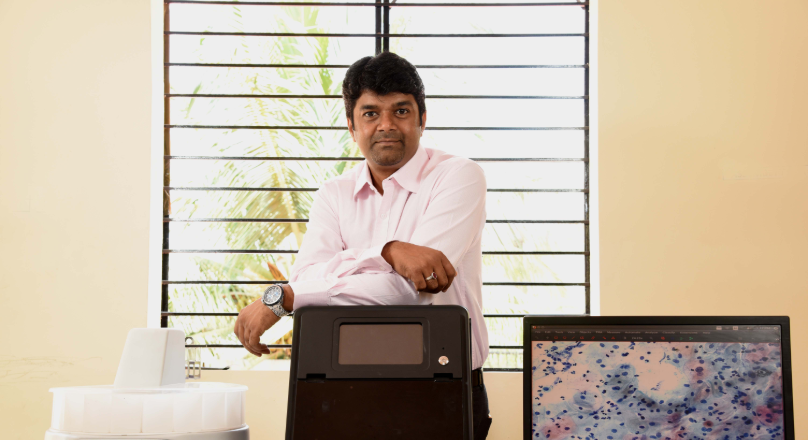
Every two minutes, a woman dies of cervical cancer in India. The incidence rate for cervical cancer is among the highest in India. 450 million plus women aged between 15 and 45 are at risk of getting affected. While its fatal in most cases, one of the most pertinent characteristics of cervical cancer is that it progresses quite slowly unlike other carcinogenic cells. There is usually a relatively broad window of detection and preventive measures taken during this time can be lifesaving.
This crucial window is what Adarsh Natarajan decided to focus on, using machine learning. His company Aindra has developed a suite of three critical products using advanced AI technologies - Aindra IntelliStain, Aindra VisionX and Aindra Astra. Collectively called CervAstra, this point of care device can detect cervical cancer using a pap smear test in under an hour. This state-of-the-art solution has successfully screened more than 700 women in Karnataka's rural pockets such as Chikkaballapur and Tumkur, working with several diagnostic labs and screening centers. Currently, the company has orders from the Delhi-NCR region, Mumbai, Hyderabad, Chennai and Jaipur amongst others, but due to COVID-19, they’re unable to cater to these orders. This product, Natarajan believes, is the need of the hour in India's rural areas which lack infrastructure, shortage of pathologists and qualified medical professionals.
Natarajan, while pursuing a management degree at the Indian Institute of Management Bangalore, briefly interacted with the Center for Public Policy after which he began working extensively on AI models for fraud detection. During this time, he came across some statistics on cervical cancer incidence in India and thought it would be hugely beneficial to address this growing problem using AI.
CervAstra To the Rescue:
Aindra’s CervAstra comprises of three products - Aindra IntelliStain, which is an automated stainer, using state of the art mechatronics and software for staining biological samples mounted on glass slides; Aindra VisionX that provides clear and clean Whole Slide Images (WSI) of the slides, enabling quicker turnaround time for pathologist and Aindra Astra, an AI platform that can facilitate computational pathology faster and make an accurate diagnosis. The initial callout by the system is then also shared with pathologists on Aindra’s proprietary Telepathology platform, Clustr. This allows the pathologists to then sign off on the report generated by the system, after confirming or amending the report presented by the CervAstra system.
"Aindra deals with plenty of unstructured data especially images. But deep learning capabilities are helping us handle the overload in data. We are using deep learning to build the core technology of clinical inference from images, coupled with optics, electronics and mechanical systems. We have built a full stack solution, comprised of hardware driven by the AI platform," explains Natarajan.
Right from when a woman in a Tier2/Tier 3 town steps into a clinic to check her symptoms, provides her samples to a lab to the inordinate wait for the results, nearly 7-8 weeks have passed. With CervAstra, the entire process is expedited to just under an hour. It is also a highly economical option - the former testing protocol would cost anywhere between Rs. 500 to Rs. 2000 but Aindra's test is between Rs. 200 to Rs. 400. The Company is ISO-13485 certified and the patent-pending products are CE Compliant. The company has a growing set of customers in Karnataka that include pathology labs and oncology centers, explains Natarajan.
One of the biggest advantages of using an AI-enabled point of care device like CervAstra is addressing the already wide gap in the doctor-patient ratio. India faces a severe shortage of medical staff, nurses, lab technicians especially in low resource areas. This device with its inbuilt features ranging from slide analysis to pointing to a possible diagnosis minimizes the work of an oncologist and provides for scope to help more women in need.
Apart from CervAstra, which was developed for cervical cancer, team Aindra is now leveraging their Computational Pathology platform comprising of all the hardware and software products, to extend to other conditions like prostrate, thyroid, oral and lung cancers.
Adoption & Other Learnings in Product Development:
Natarajan admits that while there are have been numerous challenges at different stages, challenges in driving adoption have been multifold. “As a startup, we have to contend the questions that customers might have around the brand, the longevity and also the perception that India-made products lack deep technology and quality. But with the right kind of signals like the ISO certification and the CE certification, we have been able to make inroads,” he says.
The existing gaps in Indian healthcare cannot be fixed overnight, but a significant portion of the last mile delivery can be partaken by technology. Early diagnosis through technology solutions leads to better outcomes and significantly reduces the burden on the strained healthcare ecosystem. Natarajan, who made one of the earliest forays into medical tech development using AI, thinks that the market for healthcare innovation is going to only get bigger, especially after COVID19. At such time, healthcare entrepreneurs should work with domain experts right from day one, understand the incentive mechanisms for the stakeholders, get product pricing right, and stay persistent as this is a sector that demands enormous stamina and not only strength.
COVID19 is proving to be a reckoning moment for the healthcare sector, but like many other healthcare entrepreneurs, Natarajan fears that the focus is only on select aspects of the sector and this shouldn’t adversely affect innovation and investments elsewhere. Natarajan says, “All the focus is currently on handling the pandemic and therefore, more critical and important areas of healthcare remain suspended. For example, most of the healthcare service organizations are experiencing a loss of revenue on account of their regular OPD, consultations, tests and others being drastically reduced. This has a ripple effect on other aspects of healthcare too. Hopefully things will start stabilizing in a couple of quarters.”
Mentors & Accolades:
Mentors and industry guidance are key to product development, strategy, go to market and more. Aindra Systems relies on the counsel of industry experts such as Dr. Kristian Olson, Director of CAMTECH MGH; Dr. Vani Ravikumar, Founder of RV Metropolis Bangalore, Dr. Malathi, Chief Cytopathologist at Kidwai Cancer Institute, Dr. Hazarika, HoD Pathology and Dr. Suhail, pathologist in HCG and Dr. Radheshyam Naik, Head Dept. of Medical Oncology in HCG. In addition, they are patronized by BIRAC (Department of Biotechnology), USISTEF programme, Villgro, Millennium Alliance, Government of Karnataka and others.
Cervical cancer is one of the most publicised diseases by the government. A cursory search on Google will show you that organisations and government bodies across the nation like NCBI, National Health Portal and various state health departments have been doing their bit to enhance awareness. Aindra too has been continuously devoting marketing muscle on outreach activities, stressing on early diagnosis and treatment. But is it enough? “While the govt indeed conducts screening, the effort has been largely uncoordinated on a national scale. The success of such programs relies largely on awareness in the population to keep themselves safe by undergoing early testing and screening. The way to make this work is having a coordinated effort that is being driven by awareness building as the first block in a sequence of steps.”
Aindra has been recognized as one of the earliest startups working in the area of AI in healthcare in India. Natarajan has spoken at multiple International and National forums like Harvard Global Health Institute, Washington University's Forum for India, Forbes' India Conversations. Aindra has also been sponsored by both the Govt. of India and Govt. of Karnataka to be present at BioUS 2018, BioKorea 2017, Slush Helsinki amongst others. Natarajan was also a special invitee by the US government as a sponsored delegate at the Global Entrepreneurs Summit 2016 held in San Francisco.
What Lies Ahead:
“We are working with HCG and are in talks with CMC Vellore to extend our computational pathology platform for multiple other conditions,” reveals Natarajan.
Aindra is now opening up its platform for use as a Digital Pathology platform, to be used in these times of COVID when pathologists can be enabled to Work From Home (WFH). Secondly, they have extended their telepathology platform Clustr to radiology as well, to be used for detecting early signs of pulmonary distress in COVID19 patients using chest x-rays and CT Scans.