Results for ""


AI Experts 7 Min Read Aug 09, 2023
Expert Talk - Startups are desperate to hire the right people
 Published By : Dr Nivash Jeevanandam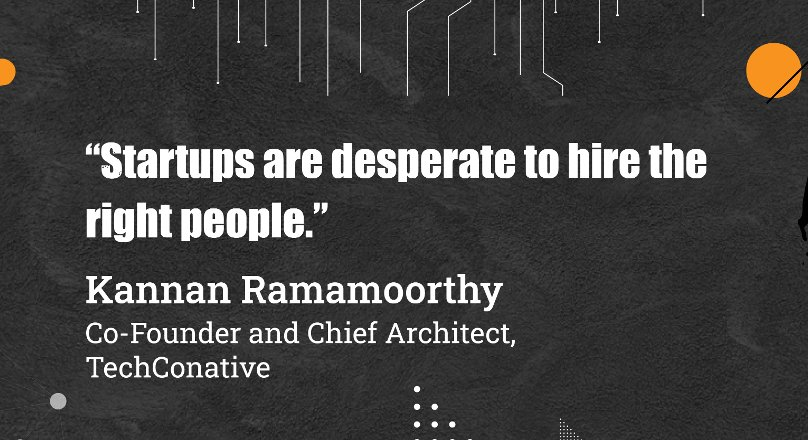
Kannan Ramamoorthy co-founded TechConative, which provides product engineering solutions to developing enterprises.
He has worked on various engineering and machine learning projects, guiding them to success.
INDIAai interviewed Kannan to get his perspective on AI.
We notice regular open-source contributions from TechConative. What is TechConative trying to solve?
TechConative is primarily a Product Engineering and R&D company. We solve business problems in the real world that our clients have. And we also help our customers to research some of the technical problems to articulate and formulate the path forward.
On the way, we create artefacts (open-source projects and writings of our experiments) out of valuable things that we figure out.
Many startups in India are making significant contributions to AI. What is TechConative doing in the field of AI? How do you leverage AI?
We're setting our foot in AI. We primarily focus on Natural Language Processing (NLP) & Generative-AI (GAI) to solve some of our client's problems.
We're dealing with clients in a profitable business with some substantial pain points that demand AI. The problems are along the varying degree of complexity, starting from basic Semantic search, Content suggestions to advanced levels such as helping QA(Quality Assurance) with AI and Code generation.
What hurdles did you experience as a founder and co-founder? What were your initial challenges in launching such a company?
The challenges that we face are multi-dimensional. Given that the question is coming from GoI magazine let me just put out a few problems which could be informative for the Government on helping startups.
When we started, as we were focussing primarily on business, we needed to be made aware of things like Startup tax holidays and other benefits.
A formal counselling board integrated as part of the registration process would be helpful in such aspects.
Below are some of the ongoing challenges:
- Regarding AI/ML for growing bootstrapped startups, infra cost is one of the huge factors for experimentation. Grants from cloud providers help a lot in these aspects. Any support the Government might provide here might be helpful.
- Regarding talent assets, startups are desperate to hire the right people. And many of the good engineers in our company joined as freshers with a good amount of training. Both the company and engineers benefit from this.
- Improving the ecosystem would be mutually beneficial so that educational institutions and industries work together to make such things happen systematically.
- When connecting business with Independent Software Vendors(ISV), events conducted by entities like "Startup TN" could be helpful. More such organized entities and events from them would be beneficial.
Can you tell us some AI tools or frameworks your company uses to ensure your products/solutions have the most outstanding customer experience?
Python and Notebooks are de-facto when it comes to AI/ML.
Additionally, we're also using/experimenting with the below tools,
- MLOps frameworks, such as MLFlow and ClearML, enable more efficient experimentation.
- Data stores that could solve both engineering and VectorStore problems, such as ElasticSearch and Supabase.
- Kubeflow for streamlined deployment.
- In the experiments with LLMs, Hugging Face's model repository and PEFT library are incredibly beneficial.
- Above all, the recent catalyst of the LLM revolution, Open AI's APIs and library of greater use for us for quick prototypes.
How do you deal with biases in AI algorithms?
Akin to the saying, "What we consume is what we are", "AI models are the data that is fed into it "(without undermining the inherent capability in the "self" and the "model").
Hence the solution lies more with the data than with the algorithm.
A simple start is to become aware of the biases and to try to minimize them consciously. For example, let's say we're dealing with an ML problem about credit risk analysis, and your solution may have bias not because you want it to be biased but because you're not aware or have taken steps for it not to be biased. Though it's possible to argue that this is a societal problem, such solutions are god-like. If you're conscious of the consequences, you can minimize the perpetuation of the bias.
We can minimize bias by diversifying our training data, using a fair base model, and conducting regular bias audits. While it's true that this bias is a societal problem, we believe in responsibly leveraging AI's power to reduce the perpetuation of biases rather than amplifying them.
How do you compete with the market's startups and top IT behemoths? What motivates you to keep going?
Given where it comes from, I assume the question is specific to AI.
In response, get-it-done is one of the attributes infused by hands-on leadership in all engineers. Some industry leaders act as our advisors, such as Sudalai Rajkumar(best known as SRK in the ML community).
With this, we're in a unique position where we can solve our customers' problems cost-effectively.
The foot we have set in AI will complement the engineering excellence we have inherited and built.
What advice would you provide to someone considering a career in artificial intelligence research? What should they concentrate on to advance?
My advice will be primarily for ML engineers, as that's where most of my interactions have been.
In a fast-changing profession, it's essential to keep up with the best solutions in your interests, which most engineers do, especially in ML.
On the other hand, it's also essential to become an end-to-end engineer in the area you have chosen with an end-to-end idea. Sometimes, you might not be able to make the choices, but it's good to know the answers to the questions.
For example, being an ML engineer, when working on a specific problem, it's essential to know,
- Why are we opting for an ML solution?
- Once we decide on an ML solution, what's my strategy to achieve our goal, including model choice, training strategy, testing strategy, etc?
- How will I acquire high-quality data for model training? It sometimes involves creative problem-solving.
- How can I determine if my model's performance is improving or declining? What is my testing strategy, and how can I ensure it's the best approach?
- How will I know when I've achieved my goal?
Though being end-to-end would be more than just grasping the above questions, these questions are an excellent place to start.
While answering these questions, knowing you are rational and not rational is essential. It means that you collect the data and arrive at an answer to the query rather than have a decision and arrive at the reasoning supporting it.
What academic works and publications have had the most significant influence on your life?
A lot can be mentioned here. But let me keep it short with three mentions.
- Twelve Virtues of Rationality is an essay to be referred to and thought through often.
- The Man Who Knew Infinity is about how much a single purpose can fill a person's life.
- Algorithms to Live By is about systematic thought processes on approaching specific problems and how sometimes you need "a solution" to be optimal rather than finding "the solution".
In addition to books, I draw a lot from people. Richard Feynman, Paul Graham and Srikumar Subramanian(My mentor) are a few.