Results for ""


Indian Economy 6 Min Read Aug 20, 2020
The onward march to $500 Billion starts here
 Published By : Soumitra Dasgupta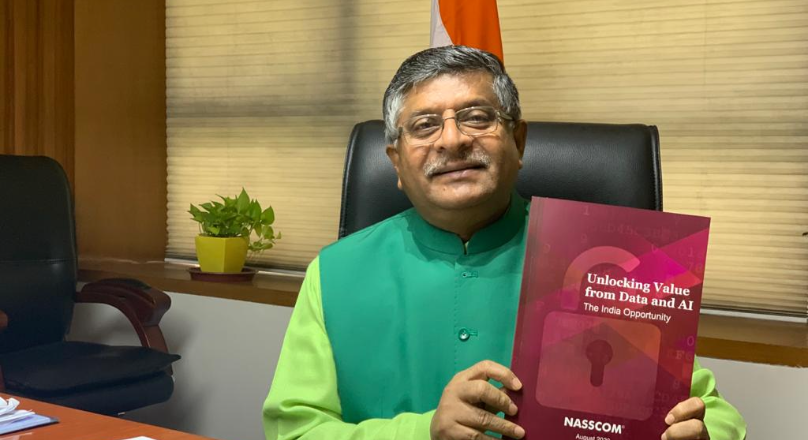
For a few months, things were out of control. It happens once in a century and COVID – 19 is humanities’ fait acompli to reckon with. There’s no going back to the old ways – probably! In a bid to save lives and livelihoods, the grand vision of a 5 trillion dollar economy got stowed away for a while and media headlines too shied away from capturing the sentiments.
The NASSCOM report, Unlocking Value from Data and AI – The India Opportunity lends heft to this grand vision and brings to the fore once again, to chart a clear path increating value worth $500 billion dollars. This report was launched by the Hon’ble Union Minister Shri Ravi Shankar Prasad at the Curtain Raiser of the NASSCOM XperienceAI Virtual Summit, to be held early next month.
India is a data-rich nation. In a country, known for its size and diversity, that powerful hand-held device in the hands of a billion+ Indians, is a bridge that connects billions of aspirations. The sheer volume of data generated from multiple sources including mobile devices gives us a sense of purpose on what can be done achieved. With earnest, we require to put in place a robust mechanism that captures data from multiple sources, processes them in a structured manner to generate actionable insights that will enable equitable growth for the citizens.
When we think of national importance, there are essentially 10 kinds of datasets that need to be prioritized. They are in the areas of finance, healthcare, farm, grain value chain, land records, road traffic, weather, satellite imagery, power & grid, and education. For instance, if we use predictive analytics to develop targeted, personalized campaigns or block-chain enabled tracking to protect against counterfeit products, our efforts will yield significant value leading up to $90 – 95 billion USD in the next five years in consumer retail. Similarly, techniques such as precision farming (heavily data-driven & analytics) if adopted as an industry-wide practice could prove to be a stepping stone towards doubling the farmer’s income. India can transform itself in all of these areas mentioned if we have an integrated approach to value creation using data & AI-enabled technologies. It is this integrated data-driven approach using AI in all these 10 areas that will create value worth 500 billion USD in the next 5 years.
Essentially, there are 5 building blocks to promote data utilization & AI
- A strategy that is data & AI vision specific to the country that prioritizes use cases based on impact. This has tosync with an integrated action plan with clearly defined targets & timelines.
- Data. We need to identify specific data sets that are required to unlock this huge potential. This will require collaboration and partnership from the ecosystem players – academia, government & private sector. Standards & governance need to be set as well. We mentioned 10 different sets but each set comprises millions of sub-sets of data lying in silos across the economy.
- The Technology Stack is already in place and we need to build on these platforms to enhance the functionalities.
- Talent – we have to work towards defining new AI roles and create an adequate talent pipeline. Right now we have about 0.5 million people who are working in AI and allied technologies. We need to increase this pool manifold.
- Execution. We need to design a national program for AI and an empowered central apex body to spearhead it. This will require a great deal of collaboration between the centre, states, and the private sector.
Coordinated actions that are needed in the next 18 months:
- We need to launch the National Program for AI and create a central, apex body that will be tasked with execution. It will work with various ministries, industry groups, and relevant stakeholders. In addition, a National Data Office needs to be established to drive the utilization of public data. States and other bodies will have to be incentivized to share data.
- In the next three months, India’s Data & AI Action Plan can be finalized by conducting workshops with various ministries and relevant stakeholders. For each stakeholder, the top three initiatives need to be identified based on pandemic response, economic revival, and support required for marginalized groups. And, agree quickly on what the short-term achievements are likely to be.
- Identify and prioritize datasets that require the government’s attention.
- Initiate 3 – 5 programs across ministries that have a socio-economic impact. This should be done in 2020 and the scale-up can happen in the next 12 months.
- Data utilization should be facilitated by providing access but with clearly defined data governance policies and standards.
- Various schemes will have to be introduced that will encourage stakeholders to engage in this mission. These stakeholders will drive the AI ecosystem and will comprise the industry, startups, civil society, and academia.
The JAM foundation is unique to India and the fountainhead of the data being generated. More than 450 million Indians have mobile internet access and about 1.25 billion have their biometric details captured, and a unique identifier issued. This is what drives connectivity and a humongous amount of data can be captured and made shareable to policymakers and developers. Data holds the key to the nation’s transformation in terms of delivery of government services and the creation of inclusive policies.
The real challenge is in the variance in data sets due to limited policies, governance, and weak enforcement. Technology can be used to “clean up” the data but it’s also about creating a high level of TRUST so that stakeholders feel encouraged to share data. 500 billion USD is too big a number to miss!