Results for ""


AI Education 6 Min Read Jul 09, 2020
Why should education be a privilege in Digital India?
 Published By : Soumitra Dasgupta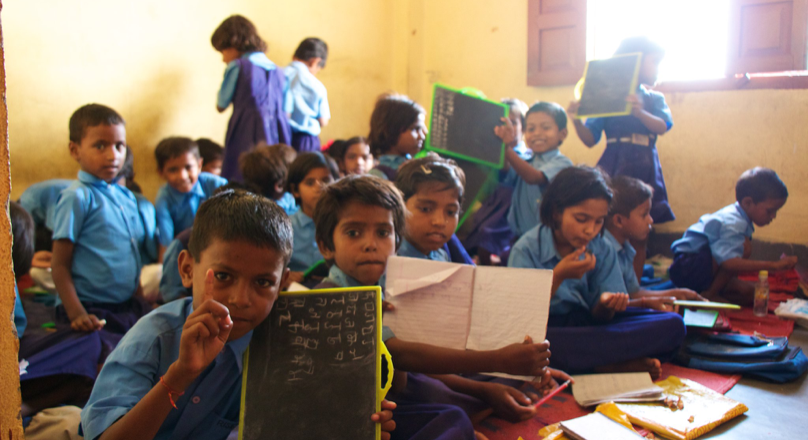
Out of the 17 Sustainable Development Goals chartered by the UN, at #4 is Quality Education with a vision towards ensuring inclusive and equitable quality education that promotes lifelong opportunities for all. Despite considerable progress, in 2017, 262 million children (globally) between the ages of 6 to 17, remained out of school, and more than half of the children and adolescents weren’t meeting minimum proficiency in reading and mathematics. The learning environment, including teachers and the infrastructure, hasn’t kept pace. In particular, the plight of young students from underprivileged sections of society and that of girls need to be highlighted (almost two-thirds of such students fare poorly).
State of Schools in India
It’s been more than a decade that the Right to Education Act (RTE) was passed in the Parliament. This has resulted in the sheer number of schools we have – 15 lakhs which is about three times the number in China. But out of these, about 4 lakh schools have less than 50 students each with two teachers only, impacting a staggering 1.5 crore young lives. Schools like these only add to the numbers, but in reality, they are unviable. It is no surprise then, despite enrolment at primary levels being at 97%, the dropout rate is exceptionally high as we go higher. The twin problem of unviable schools and a severe shortage of teachers have had a crippling effect on overall primary education in India.
The question is, should AI under these circumstances not be mistakenly perceived as luxury, or is it the diametrically opposite view which is about leveraging its immense power to personalize learning and bridging tutoring gaps? The biggest hurdle to learning is the tyranny of geography and time. The traditional structures have always favoured these two conditions rather inflexibly – school timings are fixed, and students, including teachers, live in the vicinity or within a radius of say 20 kilometres. Secondly, it falsely assumes that a one-size-fits-all approach to tutoring is the panacea for removing illiteracy. It does not take into consideration that the ability to grasp concepts and ideas can never be uniform. The weaker students are left to fend for themselves, and the result is inevitable with no reward in sight, dropout is the only alternative!
Chimple is Simple
Sutara Learning Foundation, a non-profit Indian organization, is dedicated to radically improve children’s learning through technology. Tablet prices are falling, and by leveraging the combinatorial power of Artificial Intelligence, Gamification & Cognitive Research, they have developed a chatbot that uses Natural Language Programming (NLP) to help children learn in groups or even individually.
What about pricing and outreach?
Currently, they can procure entry-level tablets for a price of $35, and considering its life is for three years, they have done the math @1$ per student – based on demand. Interestingly, the research done on cognitive development reveals that children can learn effectively with minimal intervention of teachers. With greatly improved connectivity and falling data prices, it works in a cloud environment too and opens up a whole new world of learning – particularly for students in rural areas. The teachers can play the role of a facilitator in their learning journey to ensure the right courses are selected and that resources are optimally utilized.
Students’ psychology and learning patterns are very strong parameters that impact the quality of education. A machine can identify patterns, learning disabilities, and suggest a calibrated approach dispassionately. Humans, on the other hand, are frequently short of what is called in digital parlance, “bandwidth”. And, unconditional bias is something we all struggle with, and even the best of teachers aren’t exceptions in this regard. Having said that, learning has to be purposeful. At a higher level (graduation & beyond), it should lead to employability. Similarly, at the school level, the content has to be relevant to the country’s education system, and that’s where teachers or humans in the loop play a critical role. There’s no escaping the system, marks, and admissions. Sustainable learning must take these factors with great seriousness.
The Macro View
India is home to one-sixth of the planet’s human population, and the government spends only 3% of the GDP on education. The student to teacher ration of 24:1 is lower than Brazil and China, and it should prompt us to take quick measures. It may be argued that a top-down approach has not fetched the desired results, and we need to turn it on its head. Should it be a bottoms-up one? It may be worthwhile to revisit the UN Sustainability Development Goal # 4 and make a realistic assessment of where we are and where do we want to be.
How do we use AI to monitor performance at the district level and imbibe the spirit of competition so that the laggards(districts) aren’t left behind? While making sense of the massive amounts of data points available and real-time monitoring with appropriate dashboards, can get us there. One of the goals is to substantially increase the number of teachers, and towards meeting this end, technology can be leveraged to augment the human in the loop.
Real-time text to speech and text translation systems can be used to disseminate information seamlessly in the regional languages. The Draft National Education Policy of 2019, lays emphasis on vernacular languages, and these translation systems can be integrated with DISKHA, Digital Infrastructure for Knowledge Sharing, the digital infrastructure that has been set up by MHRD or with e-PATHSHALA, (initiatives under the Sarva Shiksha Abhiyaan). For instance, if a textbook is available in Hindi, these advanced systems can translate it into other regional languages.
There are numerous areas where AI can make a huge difference to the outcomes, including biometric authentication to mark attendance, automate the grading system, and personalize education through pattern detection. These ideas may not find great resonance right away in all of India’s 6 lakh villages, but with clearly defined outcomes that are measurable, we could be very close to overall 2030 vision in sustainable education. We may even surpass it!
Sources of Article
Image by José Antonio Morcillo Valenciano Via Flickr