Results for ""


XperienceAI 4 Min Read Sep 04, 2020
Xperience AI Virtual Summit: Why Telangana is the role model for Indian states to emulate
 Published By : Sindhuja Balaji
Dynamic, erudite and passionate about technology, KT Rama Rao or KTR as he fondly referred to, doesn’t immediately strike you as the stereotypical Indian bureaucrat. But he is definitely a symbol of the future of politics in India. He is certainly one of the most tech-aware politicians today, and has played a key role in positioning Telangana as a futuristic hub for advanced tech development and innovation. At the Xperience AI Virtual Summit, Keshav Murugesh, CEO of WNS and former chairman of NASSCOM engaged in a fireside chat with KT Rama Rao, Minister of Municipal Administration & Urban Development and IT & Commerce, Government of Telangana, on India’s AI imperative and the future of Intelligence Technology.
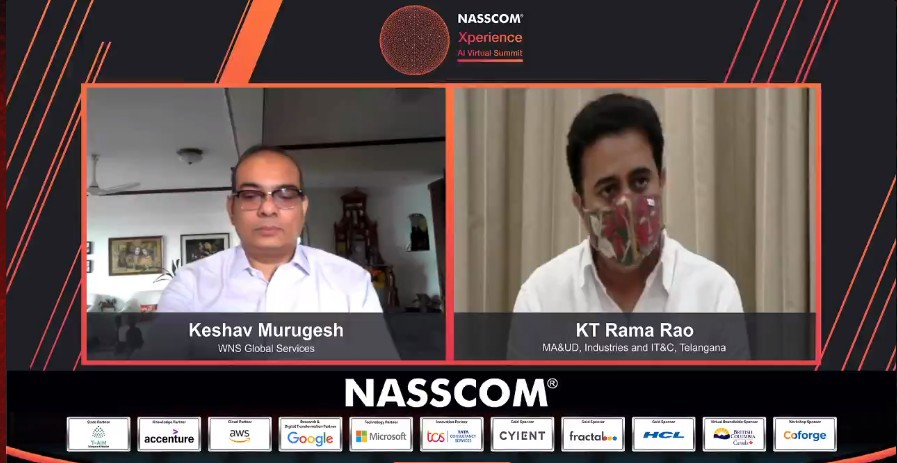
Before kicking off the conversation, Rao made a disclaimer rather disarmingly: “I’m not a technologist by training. I understand technology and how it can benefit the common man. As a politician, this understanding is very critical.” This pretty much sums up how politicians of today need to approach AI. Rao went on to explain how data driven decision making and predictive modelling will define governance here on.
The Telangana government is currently driving digital transformation on the back of a six-prong strategy:
- Data
- Skilling
- Innovation & Research
- Adoption
- Responsible AI
- Enabling funding opportunities
With 2020 being declared by the Govt of Telangana as the Year of AI, a key activity since its inception has been forging strategic partnerships with a range of organisations in the private sector, academia and not for profits such as Intel, IIT Hyderabad, Public Health Foundation of India and World Economic Forum (India Chapter). Last month, the government launched the AI4AI or Artificial Intelligence 4 Agricultural Innovation in collaboration with the Center for Fourth Industrial Revolution (C4IR) World Economic Forum. The team from C4IR worked closely with the Prof Jayashankar Telangana State Agricultural University and the Telangana Govt’s ITE&C department to identify and drive the use of AI in agriculture and farming, and ensure this has ground level impact.
Another key development by the government is the promulgation of the Open Data Policy, as early as 2016, meant for proactive data sharing whilst addressing key safety and security concerns. This also paves the way for key partnerships with enterprises offering high speed computing capabilities to process the enormous amounts of data that the government can now provide.
While gaining technical knowledge may be a stretch, understanding the basics and the impact of technology for social good is essential. Efforts are being ramped up within the government to upskill ministers and their teams to be more tech-aware. This would require a PPP (public private partnership) and multi stakeholder engagement model.
All these efforts take time, and there is the added caveat of doing so in a responsible manner. The pace of tech innovations doesn’t allow one the luxury of time to get acquainted. Simultaneously, it is important to understand the ethical and legal implications of technology, especially sensitive subjects like data use and user privacy. This is a global challenge, and it’s a space that’s evolving everyday. What evokes confidence is the government’s keenness in “getting it right” with ethics, and this is evident that Responsible AI figures as one of the six strategies for AI adoption in Telangana.
With a solid AI strategy, Govt of Telangana is now focusing on driving this tangible impact in select sectors or focus areas like agriculture, health and education. Specific initiatives like Regulated Farming, which aims at demand driven farming that would benefit the farmer and consumer.
Sources of Article
Tabrez Syed: Unsplash